Kenya’s fragile economic recovery is facing fresh strain as global shocks and domestic challenges converge, threatening to undo gains made after a difficult period of financial instability. A new report by Mauritius Commercial Bank (MCB), the Africa Economic Compass, shows that while the country has made significant progress in stabilising its economy, emerging risks are beginning to test that resilience.
Just a year ago, Kenya was navigating a period of acute refinancing stress marked by fears of a Eurobond default and weakening external buffers. That phase has since eased, with improved access to international capital markets, stronger foreign exchange reserves, and a sovereign rating upgrade that restored investor confidence. These gains helped stabilise the Kenyan shilling and provided breathing room for the government to manage its obligations more effectively.
However, the global environment has shifted sharply, and Kenya now finds itself exposed to new external shocks. The escalation of tensions in the Middle East has pushed up global oil prices, creating immediate pressure on the Kenyan economy, which relies heavily on imported fuel. According to the report, about 60 percent of Kenya’s fuel imports originate from the Middle East, leaving the country vulnerable to supply disruptions and price volatility.
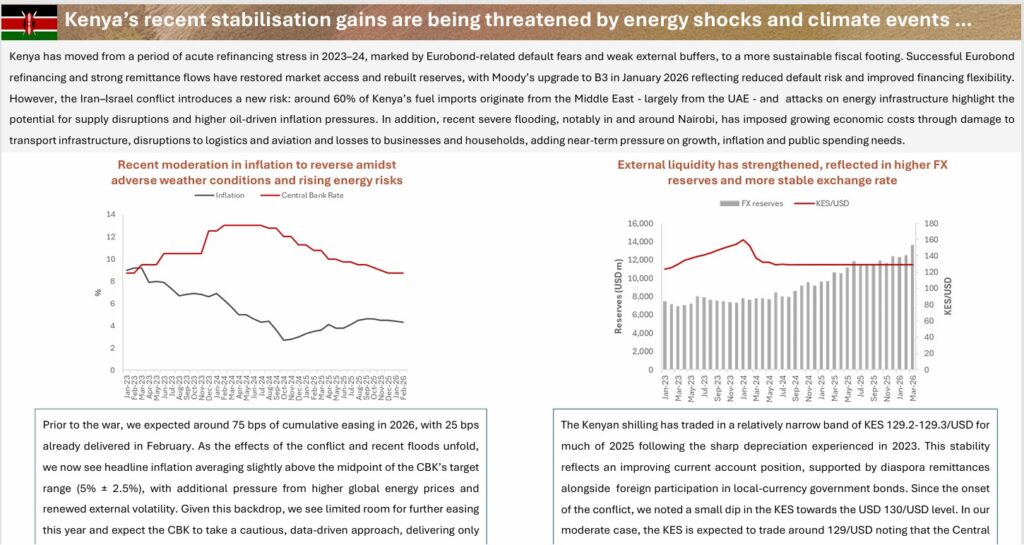
The impact is already being felt across the economy. Rising fuel costs are feeding into higher transport and production expenses, which in turn are driving up the cost of living. Inflation, which had begun to moderate, is now under renewed pressure as both energy and fertiliser prices increase. For households, this means higher food prices and reduced purchasing power, while businesses face rising operational costs that could slow growth.
At the same time, the government is being forced to step in to cushion citizens from the rising cost of living. Measures such as potential fuel tax adjustments and the use of stabilisation funds are being considered to ease the burden. While these interventions may provide short-term relief, they also place additional strain on public finances, complicating efforts to maintain fiscal discipline.
Compounding the situation are recent climate-related shocks that have disrupted economic activity. Severe flooding in parts of the country, including Nairobi, has damaged infrastructure, affected transport networks, and slowed business operations. These disruptions are adding to the pressure on growth and increasing the government’s spending needs at a time when resources are already stretched.
Despite these challenges, the Kenyan shilling has remained relatively stable, supported by strong diaspora remittances and improved foreign exchange reserves. The currency has traded within a narrow range of around 129 shillings to the dollar, reflecting a level of confidence that had returned to the market. However, analysts warn that this stability could come under pressure if external shocks persist and the cost of imports continues to rise.
The Central Bank now faces a difficult balancing act. While there is a need to support economic growth through lower interest rates, rising inflation risks limit the room for further easing. The report suggests that policymakers may adopt a more cautious approach, delaying significant rate cuts as they monitor the evolving situation.
Kenya’s debt position also remains a key concern. Although recent refinancing efforts have reduced immediate risks, the country still faces substantial external debt obligations in the coming years. Managing these repayments while dealing with rising costs and economic shocks will require careful fiscal management and sustained revenue mobilisation efforts.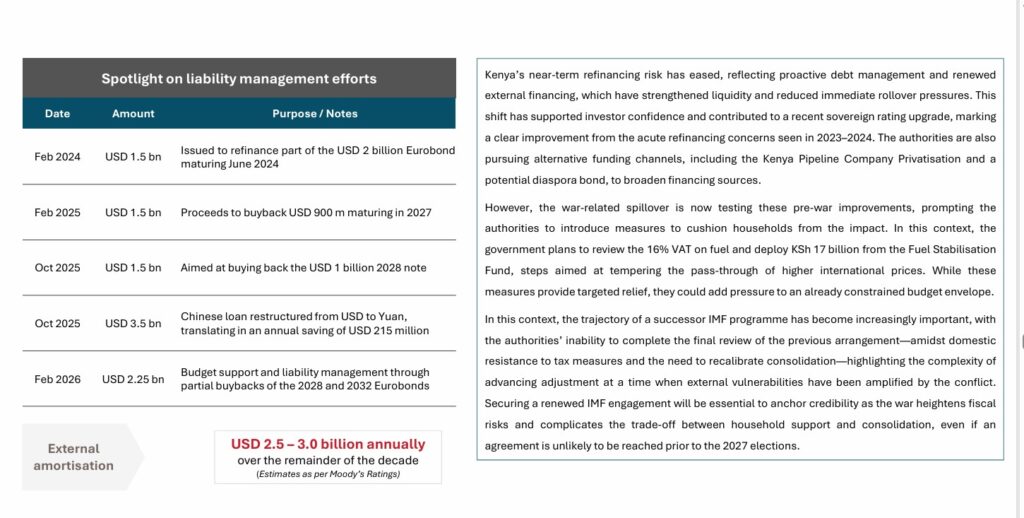
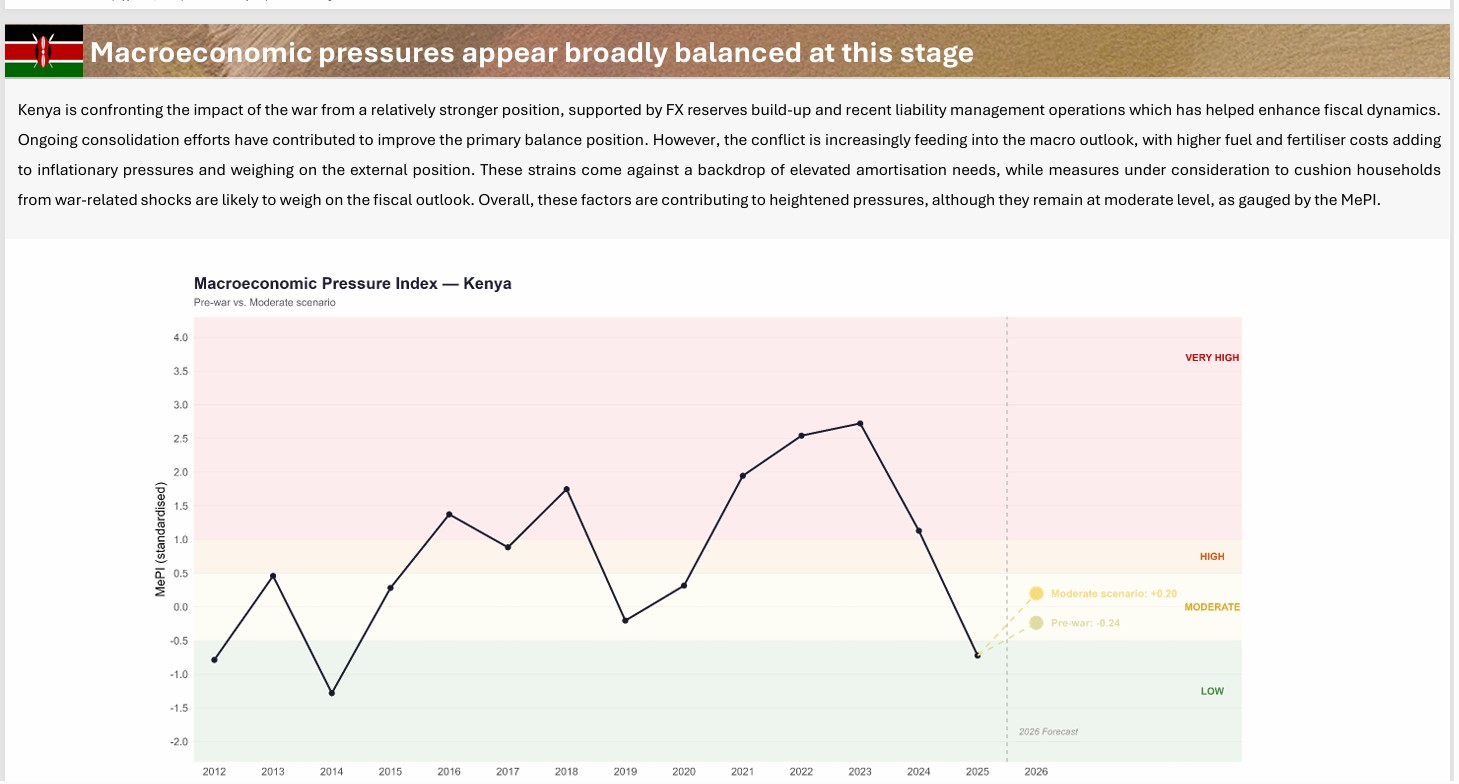
Overall, the report paints a picture of an economy at a crossroads. Kenya has made notable progress in restoring stability, but that progress is now being tested by forces largely beyond its control. The Macroeconomic Pressure Index shows that while pressures remain moderate, they are rising, signalling a more fragile outlook in the months ahead.
For policymakers, the challenge is clear. They must protect the gains achieved while navigating a more uncertain global environment. For ordinary Kenyans, the concern is more immediate. The cost of living is rising again, and the risk of economic strain is becoming harder to ignore.


