Albert Ojwang, a 31-year-old Kenyan social media user, is dead after being held by police. His arrest, transfer, and death have sparked outrage across the country.
Ojwang was arrested in Homa Bay after writing a Facebook post that criticized Deputy Inspector General of Police, Eliud Lagat. Police claimed the post was defamatory. Instead of charging him locally, they moved him to Nairobi — over 250 kilometers away. The Law Society of Kenya says there was no court order allowing this transfer. Lawyers call it illegal.
He was held at Central Police Station. Days later, police said he was found unconscious in his cell. They claimed he had banged his head on the wall. He was rushed to Mbagathi Hospital. He was pronounced dead on arrival.
But his family and lawyer saw his body. They say he had head and shoulder injuries. They say blood was coming from his nose and mouth. They don’t believe the official story.
The Inspector General of Police has since interdicted the Officer in Charge and other officers who were on duty that night. IPOA has launched an investigation. But many Kenyans say this is not enough.
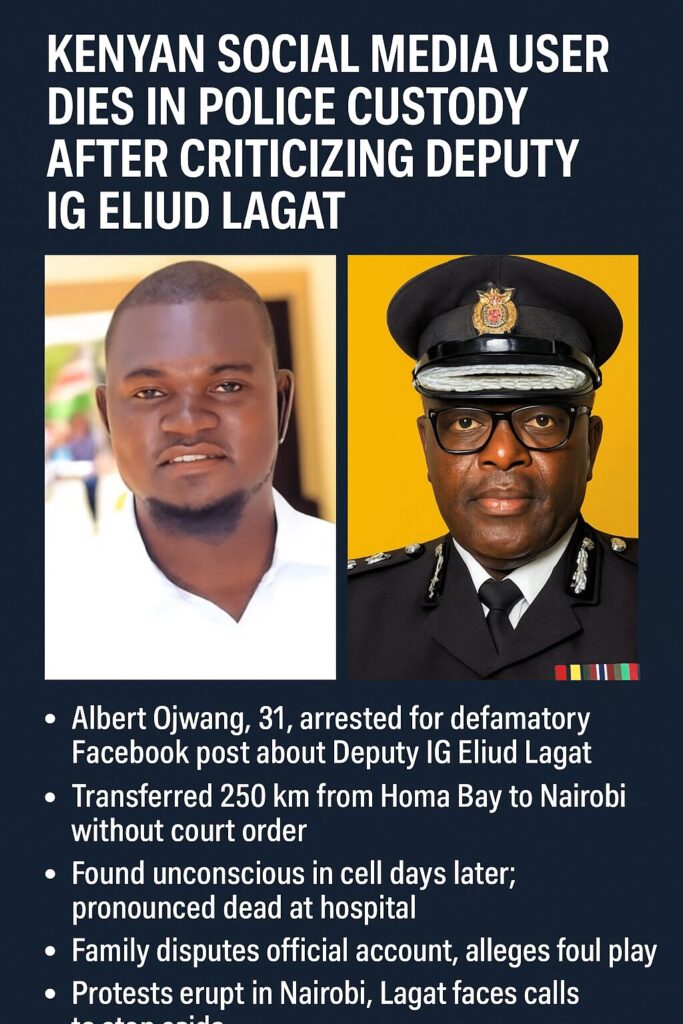
They are asking hard questions. Why was Ojwang moved to Nairobi? Why wasn’t he charged in a local court? Why was the complainant, Deputy IG Eliud Lagat, not suspended? Why did a man die in police custody over a Facebook post?
Protests broke out in Nairobi after news of Ojwang’s death. Activists gathered at City Mortuary. They marched on Ngong Road, chanting “Lagat must go.” Some called for President Ruto to speak up. Others demanded arrests. Social media exploded with anger. People accused the police of silencing voices.
Former Deputy President Rigathi Gachagua joined the debate. He said Lagat must step aside. He said the arrest and death of Ojwang raise serious concerns. He blamed the government for running what he called a “blood-based system.”
The Law Society of Kenya also spoke out. They said the way Ojwang was arrested and moved shows “bad faith.” They want full investigations. They want justice. They don’t believe the version given by police.
People across the country are angry. They say Ojwang didn’t deserve to die. They say this could happen to anyone. They say it’s about more than one man. It’s about rights. About free speech. About power.
Ojwang’s death has become a symbol. A warning. If someone can be arrested and die for a Facebook post, what protection do you have?
You post something critical — will you be next?
You speak out — will they come for you?
Your child is arrested — will they come back alive?
This is not just a tragedy. It’s a crisis. A man is dead. The people responsible are still in office. The truth is still hidden.
Kenyans want answers. They want accountability. They want change.
Albert Ojwang had a phone, a voice, and an opinion. That should never cost anyone their life.


