President William Ruto’s dramatic purge in Kenya’s energy sector has exposed what investigators describe as a deeply entrenched network of politically connected businessmen, shadow companies, and compromised officials that allegedly manipulated oil supply contracts and siphoned millions from public resources, with fresh company registry documents now linking the scandal to a powerful Coast-based business family operating through a complex web of petroleum firms and offshore corporate structures.
The unfolding investigation, which has already led to the arrest and dismissal of senior energy sector officials, is rapidly expanding beyond government offices into the private companies suspected to have benefited from the fraudulent oil supply arrangements.
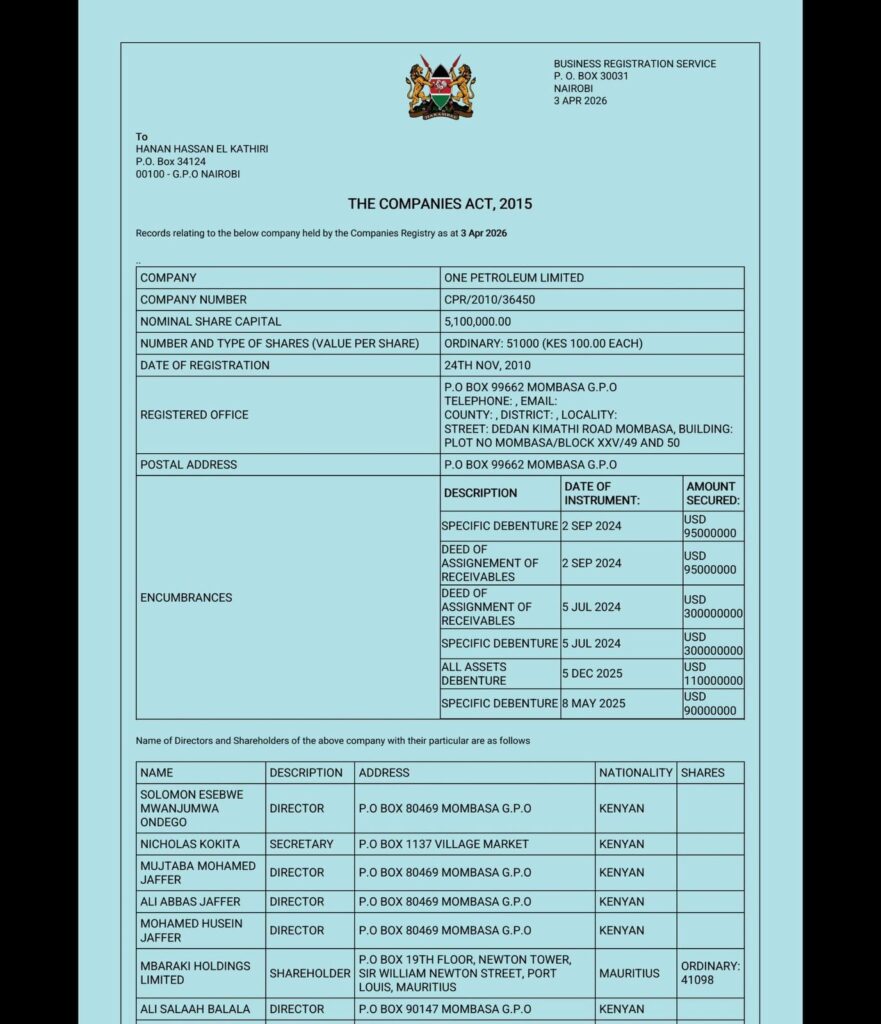
At the center of the storm sits ONE Petroleum Limited, a Mombasa-registered petroleum trading company whose ownership and control structure, according to official Companies Registry documents, connects to prominent figures in the coastal business elite and a network of shareholders stretching as far as Mauritius.
According to the official records obtained from the Business Registration Service, ONE Petroleum Limited was incorporated on 24 November 2010 and operates from offices along Dedan Kimathi Road in Mombasa, strategically positioned within the country’s key oil import and distribution corridor.
The firm holds a nominal share capital of KSh 5.1 million with 51,000 ordinary shares, yet its financial activity, including major debt instruments and secured facilities worth tens of millions of dollars, reveals an operation that far exceeds the modest corporate structure listed on paper.
Corporate filings show the company’s directorship includes Solomon Esebwe Mwanjumwa Ondego, Mujtaba Mohamed Jaffer, Ali Abbas Jaffer, Mohamed Husein Jaffer, and Ali Salaah Balala, while Nicholas Kokita serves as the company secretary.
The involvement of the Jaffer family, a well-known business dynasty within the coastal petroleum trade, immediately raises questions about whether the scandal that has shaken the energy sector may be rooted in longstanding networks of oil importers who have historically controlled large portions of Kenya’s fuel supply chain.
The documents further show the presence of Mbaraki Holdings Limited, a Mauritius-registered entity listed as a shareholder, holding 41,098 ordinary shares, which introduces an offshore financial component that investigators say is often used to obscure beneficial ownership and move money across jurisdictions beyond the reach of local regulators.
Financial encumbrances filed against the company reveal a pattern of aggressive borrowing and asset pledging that illustrates the scale at which ONE Petroleum has been operating behind the scenes.
Corporate filings indicate multiple secured debt instruments including a USD 95 million debenture issued on 2 September 2024, another USD 300 million security dated July 2024, and additional asset-backed debentures totaling more than USD 110 million, suggesting that the company has been operating within financial structures capable of moving billions of shillings through Kenya’s petroleum supply chain.
Investigators examining the broader oil procurement scandal believe that these corporate structures may have been used to channel fuel supply contracts, manipulate import arrangements, and leverage government approvals that allowed select companies to dominate high-value petroleum deals while locking out competitors.
Investigators say the scale of the scandal became even clearer after a series of coordinated searches carried out at the residences of the three main suspects, where detectives reportedly recovered close to KSh 500 million in cash and assets believed to be proceeds from the suspected oil deal.
According to officials familiar with the operation, the money was discovered hidden in various locations within the homes, raising serious questions about how such vast sums could have been accumulated outside official financial systems.
Authorities believe the recovered funds may be directly linked to payments made through the controversial petroleum transactions now under investigation, and forensic auditors are working to trace the money trail to determine how the funds moved between government officials and the private companies at the center of the energy sector scandal.
The explosive developments come amid a sweeping crackdown ordered by President Ruto after intelligence reports revealed suspicious transactions and procurement irregularities within Kenya’s energy sector that allegedly involved senior government officials working closely with private oil traders.
The president publicly declared that no individual would be spared in the investigation, warning that the energy sector had become a playground for powerful cartels exploiting national fuel supply systems for private enrichment.
As investigators dig deeper into company records, the names appearing within the shareholder registers and directorship lists are increasingly pointing toward a long-standing network of coastal businessmen whose interests extend across petroleum importation, fuel storage, shipping logistics, and fuel distribution across East Africa.
Analysts familiar with the petroleum trade say the involvement of such individuals is not surprising given the strategic position of Mombasa Port, which serves as the main entry point for petroleum products destined for Kenya, Uganda, Rwanda, South Sudan, and parts of the Democratic Republic of Congo.
Control of petroleum import companies operating out of the port effectively means influence over billions of dollars in regional energy trade.
The scandal also draws attention to another major energy player listed in the corporate registry records, Oryx Energies Kenya Limited, a multinational petroleum firm incorporated in Kenya in 2003, whose ownership structure connects to international shareholders including Oryx Energies SA of Switzerland and Overseas Petroleum Holdings SA. The company’s directorship includes Sidy Bane, August Dominic Mrema, and Herve Christophe Bouvett, with Conrad Nyukuri listed as company secretary.
Below are documents from registrer of companies:
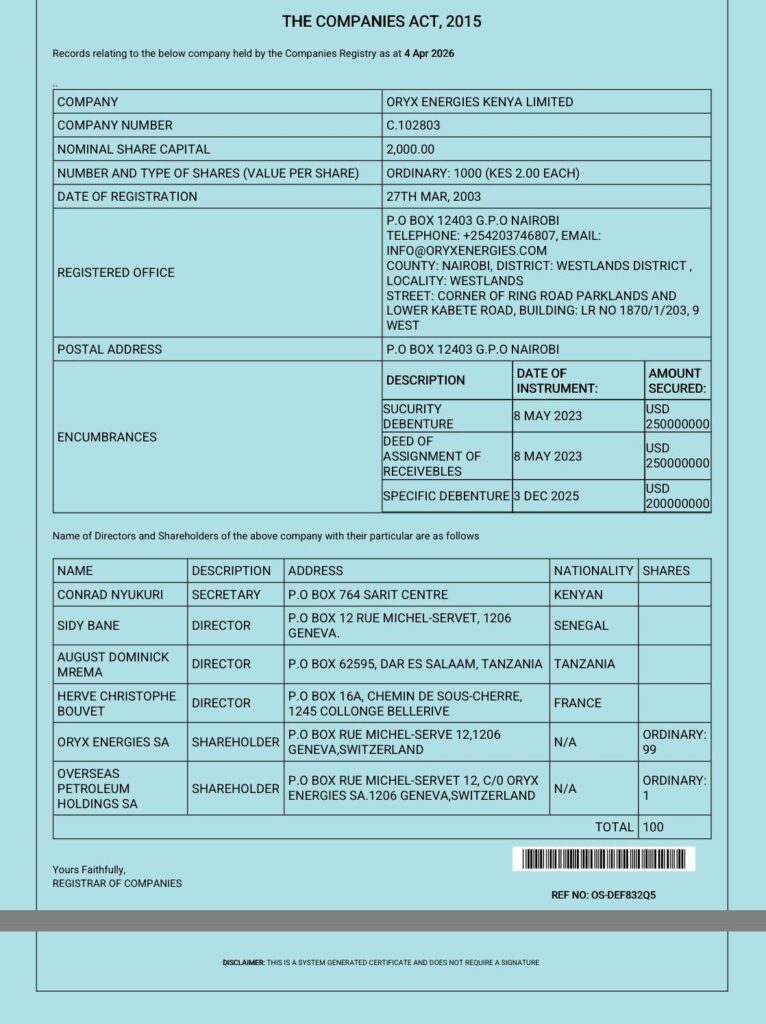
While Oryx operates as a legitimate multinational petroleum supplier across Africa, investigators are reportedly examining whether the company’s financing arrangements, including security debentures worth USD 250 million, intersected with transactions currently under investigation within Kenya’s troubled fuel procurement system.
The deeper investigators probe, the clearer it becomes that Kenya’s oil sector has been operating within a tightly controlled ecosystem where a small circle of companies, directors, and politically connected businessmen repeatedly appear across multiple petroleum supply entities, raising suspicions that the industry may have been captured by an entrenched cartel operating behind layers of corporate paperwork.
Energy sector insiders say the scandal may only represent the surface of a much larger scheme involving preferential allocation of fuel import quotas, manipulation of petroleum tender processes, and the strategic use of offshore companies to shield the true beneficiaries of lucrative oil contracts.
Investigators are now reviewing procurement approvals, financing arrangements, and shipping records associated with several petroleum import deals that allegedly bypassed proper oversight, allowing select companies to secure multi-million dollar contracts that may have been inflated or irregularly awarded.
Financial analysts reviewing the corporate filings warn that the presence of foreign-registered shareholder entities such as Mauritius-based holding companies raises additional concerns about profit shifting, tax avoidance, and the potential movement of funds outside Kenya’s financial monitoring systems.
For years, Kenya’s petroleum sector has faced accusations of being dominated by powerful business families and politically connected traders who control supply routes, influence fuel pricing structures, and negotiate directly with government agencies responsible for regulating the industry.
The latest scandal threatens to expose how deeply those networks may have penetrated the country’s energy governance structures.
What began as a routine investigation into suspicious oil procurement contracts has now grown into a full-scale inquiry into the financial architecture of Kenya’s petroleum trade, with investigators examining whether certain companies were deliberately positioned to benefit from manipulated import schedules, favorable financing arrangements, and insider access to government approvals.
The arrests of senior energy sector officials have intensified public scrutiny, with many Kenyans now demanding transparency about how a critical sector responsible for powering the national economy could have been compromised by what appears to be a coordinated network of corporate actors and insiders.
As investigators continue tracing payment trails, corporate filings, and shipping documentation, attention remains firmly fixed on the companies and directors whose names continue to appear across multiple petroleum transactions.
For President Ruto, the investigation represents a high-stakes test of his administration’s commitment to dismantling entrenched corruption networks within strategic sectors of the economy.
Having publicly declared that the government would leave no stone unturned, the coming months will reveal whether the probe ultimately stops at the arrested officials or reaches the powerful businessmen whose companies sit at the heart of Kenya’s petroleum supply system.
For now, the documents emerging from the Companies Registry have already revealed enough to raise serious questions about the true power structure behind Kenya’s oil trade, exposing a corporate web stretching from Mombasa’s port corridors to offshore financial centers and multinational petroleum networks, all converging around an industry that moves billions of shillings every year through the arteries of the Kenyan economy.


