Kenyan security agencies have disrupted what investigators believe was part of a dangerous terror logistics network after recovering dozens of bales of suspected Al-Shabaab combat uniforms hidden within the busy Eastleigh business district in Nairobi.
The intelligence-driven operation was carried out by a joint security team led by detectives from the Directorate of Criminal Investigations (DCI) Starehe unit and officers from the Anti-Terrorism Police Unit (ATPU). The raid exposed what authorities say could be a cross-border supply chain suspected of transporting military-style uniforms destined for extremist fighters.
The operation followed a critical breakthrough earlier this month across the Kenya-Somalia border. On April 6, 2026, security forces in Jubaland intercepted 25 bales of suspected Al-Shabaab camouflage uniforms in Dhobley, a key border town frequently used by smuggling networks operating between Somalia and Kenya.
That discovery immediately raised alarm among regional security agencies.
Investigators believed the seized uniforms were part of a larger shipment moving through a network that stretched beyond Somalia and into Kenya. Intelligence gathered during the Dhobley interception pointed to a suspected recipient identified as Abdi Hakim, who was arrested and remains in custody as authorities attempt to unravel the network behind the shipment.
Further investigations quickly revealed that part of the consignment had already been transported into Kenya.
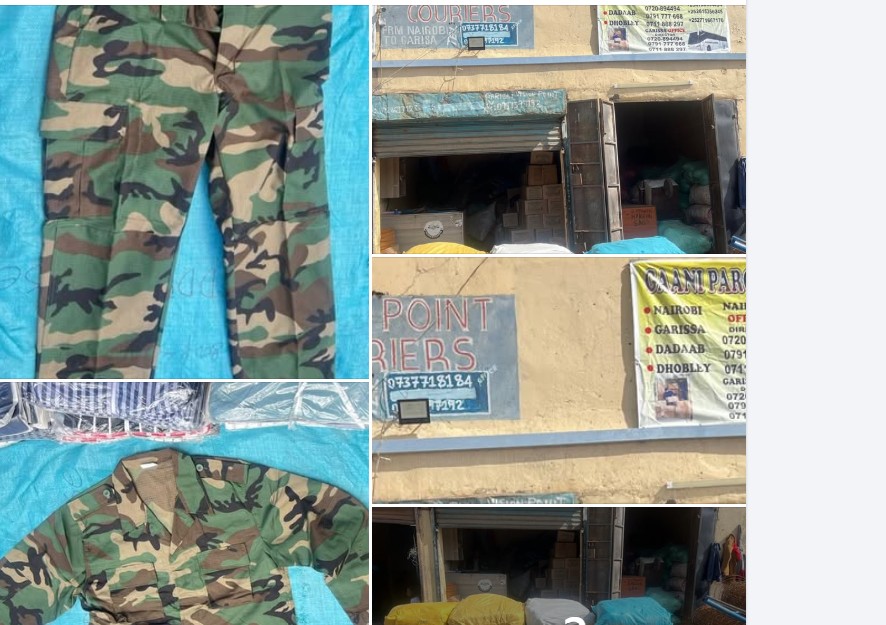
Detectives traced the cargo to Eastleigh, Nairobi’s bustling commercial hub known for its dense network of cargo businesses, parcel services and cross-border trade operations. Security officers focused their attention on Gaani Parcel Express, a logistics outlet located along 12th Street near the busy KBS transport corridor.
Acting swiftly, the multi-agency team moved into the area and conducted a targeted search of several cargo facilities suspected to be involved in the shipment.
The operation led to the recovery of 11 bales containing camouflage uniforms and military-style clothing. Each bale reportedly contained 60 full camouflage uniforms and 120 matching T-shirts, suggesting the shipment had been prepared in bulk for organized distribution.
Detectives also recovered another bale containing 65 camouflage uniforms and 120 T-shirts.
The items were discovered inside a neighboring facility known as Vision Point Express, where the cargo had reportedly been moved temporarily due to lack of storage space at Gaani Parcel Express.
Authorities believe the shipment had been quietly circulating within the cargo network before being dispatched to its intended recipients.
Investigators say the uniforms bear strong resemblance to those commonly worn by fighters linked to the Al-Shabaab militant group, which has carried out numerous attacks across East Africa.
Preliminary investigations point to the involvement of several individuals suspected to be part of the logistics chain that handled the cargo once it arrived in Kenya.
The manager of Gaani Parcel Express, Omar Elmi Issack, is said to have facilitated the temporary storage of the bales after receiving them from an individual identified by investigators as Sharif.
Security agencies believe Sharif may be a key figure in the distribution chain that transported the uniforms from the port to Nairobi.
The investigation quickly expanded beyond Eastleigh.
Detectives traced the cargo back to a clearing and forwarding firm operating from Soma Towers in Nairobi known as Safe Link Cargo. Authorities suspect the company may have played a role in clearing and coordinating the shipment after it arrived in Kenya.
Investigators say records indicate that 37 bales of suspected Al-Shabaab combat uniforms were imported into the country through consolidated cargo shipments.
The cargo is believed to have originated from China, where the uniforms were allegedly manufactured before being shipped through international freight channels.
Authorities suspect the shipment entered Kenya through the Port of Mombasa, concealed among legitimate cargo consignments.
Investigators are now examining shipping documents and customs clearance records to determine how the cargo passed through port security without raising alarms.
One individual who has emerged as a central figure in the investigation is Abdiftah Aden Muhammed, an employee at Safe Link Cargo. Detectives believe Abdiftah may have played a role in coordinating the clearance of the shipment after it arrived in the country.
Investigators say communication records show links between Abdiftah, Sharif, and another individual identified as Abdikadir, forming what authorities believe may be a key operational chain behind the suspected supply network.
Security agencies suspect the group may have been working together to move the cargo from the port to Nairobi and then onward to its final destination.
Records reviewed by investigators show that the consignment was reportedly collected on April 4, 2026 by Sharif before being transported to the Eastleigh parcel outlet.
From there, authorities believe the uniforms could have been distributed further through transport networks operating between Nairobi and border regions.
Security analysts warn that such logistics chains are often used by extremist groups to move equipment across borders without detection.
Combat uniforms are particularly sensitive items because they can be used not only by militants but also by infiltrators seeking to impersonate security forces during attacks.
Authorities say the seizure of the uniforms may have prevented the equipment from reaching extremist fighters.
All recovered items have now been secured as exhibits and documented as part of the ongoing criminal investigation.
Several suspects linked to the cargo network are currently in custody under the Anti-Terrorism Police Unit as investigators work to establish the full scope of the operation.
Security agencies are now pursuing additional leads to identify other individuals who may have facilitated the shipment.
Investigators believe the Eastleigh cargo operation may be only one link in a wider regional network used to move supplies to militant groups operating in Somalia.
The discovery has raised serious concerns about how terror-linked logistics networks may be exploiting commercial cargo systems to move sensitive materials across international borders.
Authorities say the investigation remains active and more arrests are expected as detectives track the individuals involved in the supply chain.
Security officials say the operation highlights the growing importance of intelligence-sharing between regional partners in combating cross-border terror networks.
For now, the seizure in Eastleigh marks a significant blow to what investigators believe was a covert pipeline supplying equipment to extremist fighters.
And security agencies say they remain on high alert for similar attempts to move suspicious cargo through Kenya’s transport and logistics corridors.


