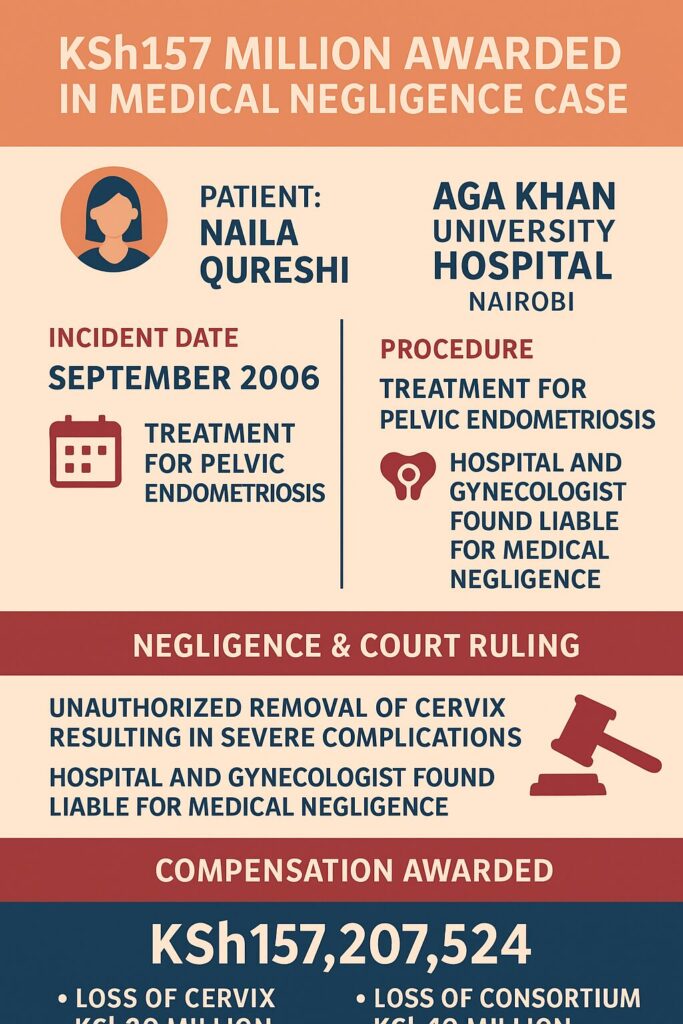
Aga Khan University Hospital, one of Kenya’s most reputable private health institutions, has found itself at the center of a medical negligence storm after the High Court in Nairobi awarded a record-breaking compensation of KSh157 million to a patient and her husband following a botched surgical operation.
The case, which dates back to September 2006, involves a patient, Naila Qureshi, who underwent what was supposed to be a routine surgery to manage pelvic endometriosis. However, what unfolded in the operating room was far from expected. According to court documents, during the procedure, the attending gynecologist — Dr. Rafique Parker — removed Qureshi’s cervix without her consent, an action that led to long-term, life-altering physical and psychological consequences.
The Surgical Blunder That Changed a Life
What was intended to be a planned removal of the uterus and ovary turned into a traumatic medical episode. The unauthorized removal of the cervix resulted in Qureshi developing a vesico-vaginal fistula, a painful and debilitating condition that causes urinary incontinence due to an abnormal opening between the bladder and the vagina.
The patient suffered for years, undergoing multiple corrective procedures — including specialized treatment in South Africa. Court records reveal that the couple had to spend over KSh7.2 million in treatment and travel expenses. But perhaps more devastating was the emotional and psychological toll the botched operation took on Qureshi and her family. She reported a complete breakdown in her sexual health and overall wellbeing, describing the years that followed the surgery as filled with pain, loss of dignity, and emotional suffering.
Gross Negligence and Institutional Lapses
Justice Mugure Thande, who presided over the case, found Aga Khan University Hospital and its attending physician, Dr. Parker, guilty of gross medical negligence. The court concluded that the removal of the cervix was done without informed consent — a grave violation of the patient’s rights and medical ethics.
In a damning revelation, it also emerged that Dr. Parker had previously been disbarred from practicing medicine in Uganda — yet Aga Khan allowed him to operate on patients in Kenya. The court ruled that the hospital should never have permitted a disbarred doctor to practice, especially without full disclosure to the patient.
Justice Thande stated in her ruling:
“The actions of the attending physician were unjustifiable and amounted to a breach of the duty of care owed to the patient. Consent is the cornerstone of medical ethics, and in this case, it was completely ignored.”
Breakdown of the Compensation
In what is now being termed one of Kenya’s most significant medical compensation rulings, the court awarded KSh157,207,524 in damages. This amount included both special and general damages:
KSh7.2 million in special damages for medical treatment and travel.
KSh30 million for loss of cervix.
KSh40 million for loss of consortium (marital companionship and affection).
KSh20 million for loss of amenities
KSh10 million for pain and suffering.
KSh20 million for diminished earning capacity.
KSh30 million for loss of society and services.
A Precedent for Medical Accountability in Kenya
This ruling is expected to set a new precedent in Kenya’s healthcare and legal sectors. It reaffirms the principle that patients must give informed consent before any major procedure, and it holds medical institutions to a higher standard of accountability. The decision has been widely welcomed by legal experts, human rights activists, and healthcare reform advocates.
It also brings into sharp focus the lack of due diligence by private hospitals in verifying the credentials and past conduct of their practicing doctors. That Aga Khan University Hospital — an institution known for high standards — failed to detect or disclose the disciplinary record of one of its practitioners is alarming.
Public Reaction and the Social Media Uproar
The court decision has sparked widespread discussion on X (formerly Twitter) and other platforms. A post by user @thee_alfa_house, who detailed the full court ruling and exposed the underlying negligence, quickly went viral. The thread has prompted an outpouring of stories from other Kenyans sharing their experiences of poor medical care and lack of accountability in both private and public hospitals.
Many users have expressed outrage that such negligence could go unnoticed for years, and are now calling for tighter regulation of private healthcare providers in Kenya.
A Wake-Up Call for the Medical Sector
The KSh157 million compensation ruling against Aga Khan University Hospital is more than a legal judgment — it’s a powerful message to Kenya’s medical fraternity that negligence, no matter how prestigious the institution, will not be tolerated.
For Naila Qureshi and her husband, no amount of money can reverse what was taken from them. But this ruling provides a measure of justice, and hopefully, a step toward ensuring no other patient has to endure what they went through.
As Kenya’s healthcare sector continues to expand, this case serves as a reminder that standards, ethics, and patient rights must never be compromised in the pursuit of profit or prestige.


