In Kenya today, the fight for privacy is more urgent than ever. Every week, there are new stories of people being abducted, dragged from their homes, or disappeared without a trace. And while the police and intelligence agencies often carry the blame, we’re ignoring one of the key enablers behind these operations: Kenya Power (KPLC).
Many people wrongly believe that companies like Safaricom or Telkom provide your exact location to the government. But that’s not how it works. Telcos can only provide your last connection to a cell tower — which usually places you somewhere within a general radius, not a specific house.
So how do security agents find the exact door to knock on?
That’s where Kenya Power comes in. And what most Kenyans don’t know is this: KPLC has already mapped your home in full detail.
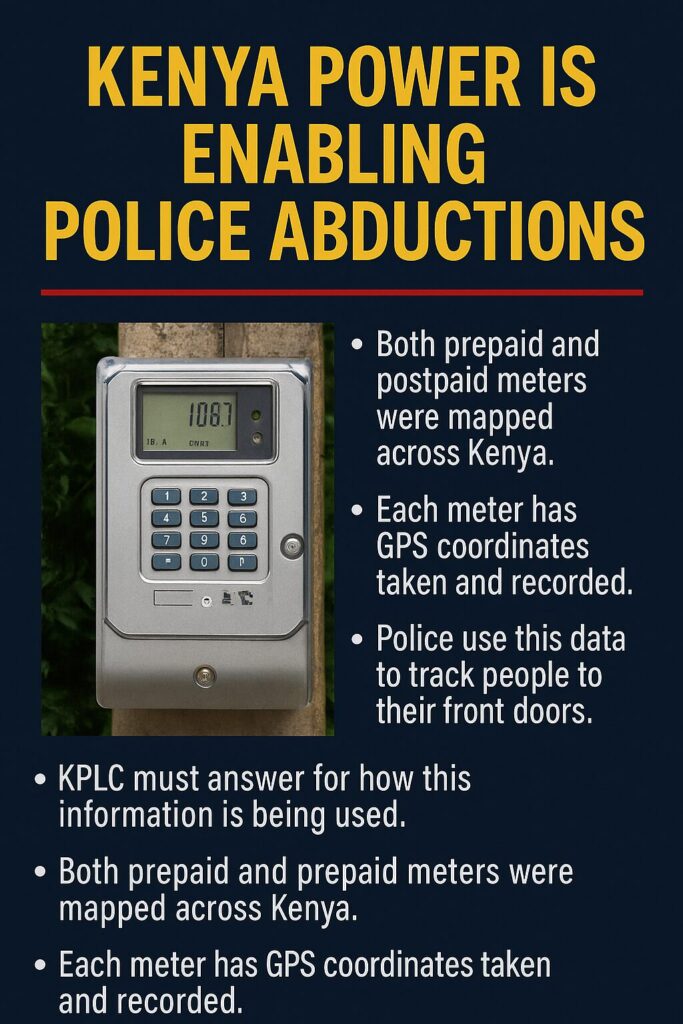
Both postpaid and prepaid meters have been mapped nationwide.
KPLC carried out a geometric meter mapping exercise, where every prepaid meter was tagged with its exact GPS coordinates. That means your meter — and the number you use to buy tokens — can be traced directly to your physical house. The link between your phone number and your home has already been recorded.
So if you use the same number to buy electricity tokens and to run your mobile phone, that number is all someone needs to find you. And in many cases, that’s exactly how abductions happen.
How the system works
You attend a protest.
You post something “sensitive” on social media.
Security agencies decide to track you.
Your phone connects to a general cell tower.
They retrieve your token payment logs.
They get the meter number linked to your number.
They check GPS data on that meter.
They arrive at your house.
That’s how abductions in Kenya happen quietly, efficiently — and with disturbing accuracy.
Is KPLC protecting your data?
That’s the big question.
Does Kenya Power ask for warrants before releasing token records to security agencies?
Is there a log of who accesses your GPS-linked meter information?
Does the Data Commissioner have oversight on how this data is used?
What happens when that information is used without a court order?
As it stands, there is no transparency. No clear public report. No policy statement from KPLC on how they handle this kind of data — or who they give it to.
This makes KPLC one of the most dangerous silent enablers of illegal surveillance and extrajudicial arrests in Kenya.
This is not a theory. This is a system.
While people assume it’s Safaricom that’s exposing them, the truth is, Safaricom cannot locate your front door. Only Kenya Power can — because they tied your phone number to your house through a smart meter and logged your GPS coordinates.
And that data isn’t just sitting idle. It’s being used.
We’ve seen it during abductions.
We’ve seen it in night raids.
And it’s always the same: people are picked up from their homes with precision — not by accident, but by design.
The silence is deadly
Where is the Office of the Data Commissioner?
Why hasn’t the public been told about the GPS tagging of meters?
Why is there no public audit on how KPLC shares data with police and intelligence units?
Kenyans gave up their privacy without knowing it.
And now that information may be used — not to serve them — but to silence them.
What you can do
Stop using your main phone number for everything.
Consider separating your electricity payment number from your primary line.
Start demanding answers from KPLC and the Data Commissioner.
Ask your MP to raise the issue in Parliament.
Speak out about the misuse of data and call for regulation.
Final word
The threat is real. The system is already in place. And the victims are growing.
Kenya Power may not be pulling the trigger. But they are opening the door.
And if we don’t hold them accountable, your data could be used to find you next.


