Kenyan Mugithi star and police officer Samuel Muchoki, popularly known as Samidoh, has responded subtly but unmistakably to President William Ruto’s recent directive encouraging police officers to shoot protesters “in the legs” rather than kill them during ongoing anti-government demonstrations.
The President’s remarks, made during a police housing project launch in Nairobi on July 9, 2025, have sparked intense public debate and condemnation from human rights groups, opposition politicians, and Kenyans on social media. Among those reacting is Samidoh, whose carefully worded social media posts have been widely interpreted as a quiet act of defiance.
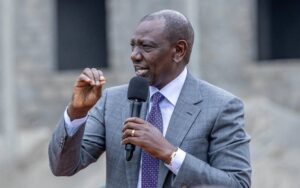
Speaking to police officers amid ongoing anti-Finance Bill protests, President Ruto said: “Anyone who burns down someone else’s business and property, let them be shot in the leg … go to hospital and later face justice in court. Yes, let them not kill, but shoot and break the legs.”
The directive comes after weeks of protests that have seen scores of young Kenyans take to the streets, demanding economic justice and the repeal of punitive tax proposals. Unfortunately, many of these demonstrations have ended violently. Human rights organizations estimate that more than 40 Kenyans have been killed since June, primarily from gunshot wounds inflicted by police.
While Samidoh has not directly commented on the president’s remarks, his recent posts have carried strong symbolic weight. On June 26, while in the United States, he shared a photo of himself wearing a face mask with the caption: “No pride for some of us without liberation for all of us. #VictoryIsCertain.”
A few days later, he posted an image of himself standing next to a mural of George Floyd, the African-American man whose death at the hands of police sparked global protests in 2020. The caption read: “Those who deny freedom to others deserve it not for themselves.” Abraham Lincoln.
The symbolism of Floyd a global icon of police brutality juxtaposed with Samidoh’s role as a serving police officer in Kenya was not lost on his followers. Fans and critics alike interpreted it as a thinly veiled critique of the Kenyan government’s handling of the protests.
Samidoh’s position is unique. He is not just a beloved public figure he is also a member of the National Police Service (NPS). For years, he has walked the line between enforcement and entertainment, often defending his dual role.
But recent events suggest that Samidoh is no longer comfortable remaining silent. His cryptic yet powerful posts point to a growing unease with the violent tactics used by the very institution he serves. They also reflect the sentiments of many within the service who are silently questioning the morality of brutal crowd suppression.
His actions have not gone unnoticed by the government. In May 2025, Samidoh was transferred to a remote location shortly after clips emerged showing crowds chanting “one term” (or “wantam”) at one of his concerts a phrase now synonymous with opposition to President Ruto’s re-election.
In June, the National Police Service issued a warrant for his arrest after he allegedly failed to return from an extended stay in the U.S., where he was seen meeting with former Interior Cabinet Secretary Fred Matiang’i.
Kenyans online have praised Samidoh for what many describe as “the bravest silence.” In a political climate where open dissent from within state institutions is rare, especially among police officers, Samidoh’s posts resonate deeply with a frustrated and grieving public.
His subtle rebellion also comes as civil society groups accuse the government of turning the police into a tool of oppression. The Kenya National Commission on Human Rights (KNCHR), Amnesty International Kenya, and other watchdogs have called for investigations into the excessive use of force during recent protests.
Opposition leader Raila Odinga and former Chief Justice Willy Mutunga have also condemned the president’s remarks, warning that encouraging officers to “shoot to injure” sets a dangerous precedent and violates constitutional protections.
His message is clear: freedom and justice must apply to all even when inconvenient. Whether his actions will inspire other officers to speak up, or whether he will face further disciplinary action, remains to be seen. But for now, Samidoh has proven that you don’t always need to shout to be heard.


