For months, Kenyan electric motorcycle riders have taken to social media to air frustrations about Spiro Bikes, raising questions about ownership terms, customer treatment, and what they describe as a growing pattern of silence and hostility from the company’s communications apparatus.
A review of dozens of posts shared on X by riders, mechanics, and industry observers reveals a recurring complaint. Kenyan riders say they are locked into restrictive lease or rent-to-use arrangements while riders in other markets are granted clearer paths to full ownership of the same electric motorcycles.
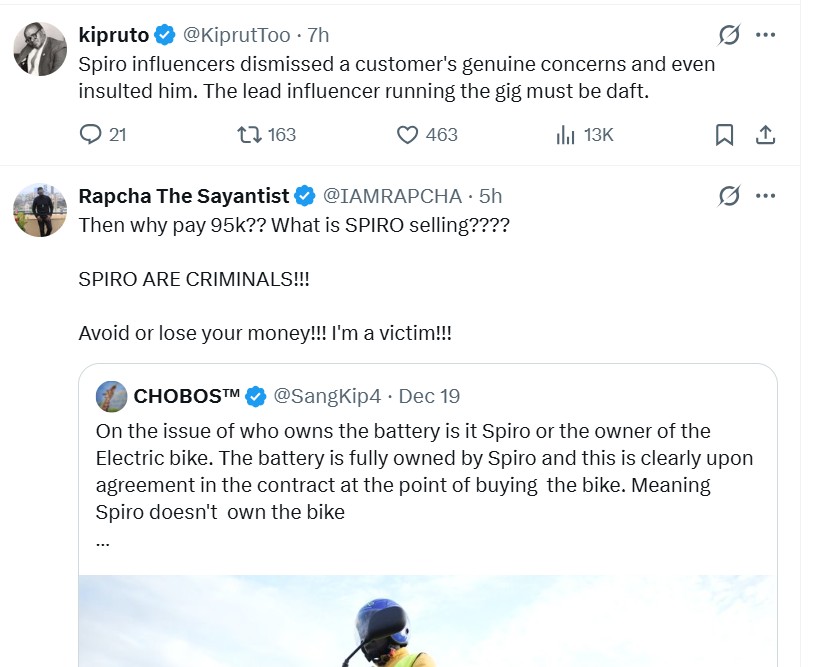
These complaints, shared openly and repeatedly, point to a widening trust gap between the company and a segment of its Kenyan customer base.
A Pattern of Complaints, Not Isolated Noise
The complaints span months and originate from different users, regions, and contexts. Many riders describe similar experiences without coordination, suggesting a pattern rather than isolated dissatisfaction.
Among the key issues raised online are
• unclear ownership terms
• inability to fully own bikes after extended payments
• sudden account restrictions
• battery performance concerns
• lack of response from customer care
• aggressive online backlash against critics
Several riders say they only realised late into their contracts that ownership was not guaranteed even after years of payments.

You pay daily.
You maintain the bike.
You service it.
You depend on it for income.
Then you discover the bike is still not yours.
Is that a fair deal?
Ownership Disparity Between Countries
A central grievance emerging from the posts is what riders describe as unequal treatment across markets.
Users point out that in countries such as Rwanda and other African markets where Spiro operates, riders reportedly receive clearer ownership timelines or outright ownership after completing payment plans.
Kenyan riders ask a simple question.
Why is ownership possible elsewhere but not here?
They argue that Kenya remains one of Spiro’s largest and most visible markets, yet riders here feel locked into endless repayment cycles with no asset to show for it.
For boda boda riders, ownership is not a luxury.
It is security.
It is dignity.
It is future planning.
Without ownership, a rider remains vulnerable.
Silence Where Answers Are Needed
Another recurring issue in the posts is communication or lack of it.
Riders say they have raised concerns through official channels
emails
service centres
customer care lines
Many claim they received no response or generic replies that failed to address the core issues.
When frustration spills onto social media, riders say the company rarely offers clear explanations publicly.
Why are ownership terms different?
Why are contracts unclear?
Why are riders penalised for asking questions?
Silence creates speculation.
Speculation fuels anger.
Claims of Online Intimidation
One of the most serious allegations raised by users is the claim that individuals who criticise Spiro online are subjected to coordinated online attacks.
Several posts accuse paid influencers and anonymous accounts of insulting, mocking, and discrediting riders who speak out.
According to these users, instead of engaging critics with facts, explanations, or empathy, the response becomes personal and hostile.
They ask
Why attack customers instead of answering them?
Why ridicule people who depend on your product to survive?
These allegations remain claims shared by users online. However, the consistency of the complaints has intensified scrutiny of Spiro’s communications strategy in Kenya.
Spotlight on the Communications Department
As pressure mounts, attention has turned toward Spiro’s communications leadership.
Users openly name the company’s Head of Strategic Communications, Flora Limukii, accusing the department of failing to manage the crisis responsibly.
Critics argue that communication is not just about branding or visibility.
It is about listening.
It is about accountability.
It is about respect.
From the perspective of disgruntled riders, the current approach has widened the gap rather than closed it.
When customers feel unheard, they shout louder.
Why This Matters Beyond Spiro
This issue goes beyond one company.
Kenya is positioning itself as a hub for electric mobility.
Boda boda riders form the backbone of that transition.
If riders feel exploited, trust in green transport collapses.
The questions raised online cut to the heart of ethical business practices.
Can a green solution still be unjust?
Does sustainability excuse inequality?
Who protects riders in emerging tech markets?
What Kenyan Riders Are Asking For
The demands shared online are not complex.
Riders want
• transparent contracts
• clear ownership timelines
• equal treatment across countries
• respectful engagement
• protection from online harassment
Most say they do not want confrontation.
They want clarity.
At the time of publication, Spiro Bikes had not issued a detailed public response addressing the ownership disparity claims raised by Kenyan riders.
The company is invited to respond to the following questions
• Why do ownership models differ across markets
• What is the long term ownership plan for Kenyan riders
• How does Spiro handle online criticism from customers
• Does the company work with influencers to respond to critics
Any response will be published in full.
A Defining Moment for Electric Mobility in Kenya
The electric motorcycle revolution promises cleaner cities and lower fuel costs.
But progress cannot come at the expense of fairness.
If riders feel trapped instead of empowered, the model fails.
The voices on social media may be messy.
They may be angry.
They may be emotional.
But they are consistent.
And consistency demands attention.


