Fresh whistleblower allegations have thrown the Ministry of Information, Communications and the Digital Economy into the spotlight after frustrated insiders accused Chief Finance Officer M.M. Mosiria of allegedly crippling operations through financial delays, neglected field stations and what officers describe as a growing culture of fear and favoritism inside the ministry.
According to internal complaints shared anonymously by officers within the Directorate of Information and the Kenya News Agency, ministry staff are increasingly being forced to undertake official government duties without facilitation, subsistence allowances or even basic operational support while critical communication functions continue deteriorating.
The whistleblower claims the situation has reached alarming levels, with some officers allegedly forced to contribute money from their own pockets to fuel a government vehicle during an official trip back to Nairobi after the assigned fuel allocation proved inadequate. Insiders say the officers had not even received their travel allowances at the time and were left stranded despite carrying out state assignments.
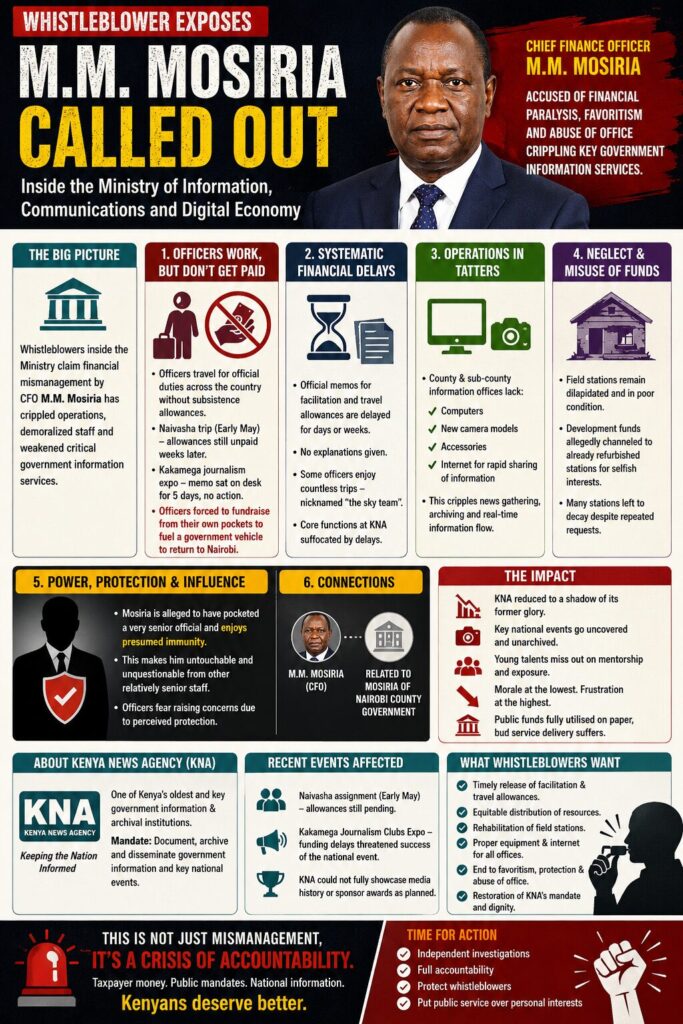
At the center of the allegations is M.M. Mosiria, who officers accuse of deliberately delaying approvals for facilitation and travel allowances for staff deployed on official assignments across the country. The whistleblower alleges that official memos seeking funding for assignments routinely remain unattended for days or weeks, crippling planned government activities and leaving officers frustrated and demoralized.
One example cited involves a journalism clubs expo organized in Kakamega by the Media Council of Kenya, where Kenya News Agency officers invited to mentor students and mount a historical media exhibition allegedly travelled without receiving the required facilitation despite funding requests reportedly being submitted well in advance.
The whistleblower now claims the Kenya News Agency, once regarded as a key pillar of government information dissemination and media archiving, has become “a shadow of its former glory” because of persistent financial suffocation allegedly originating from the ministry’s finance department.

Insiders further allege that county and sub-county information offices are operating without basic equipment required to function effectively. According to the claims, departments lack computers, modern cameras, accessories and reliable internet connectivity needed for rapid transmission of news and government information from the field.
The allegations also suggest severe imbalance in how operational resources are allegedly distributed. While some officers reportedly struggle to secure approval for official assignments, others are allegedly enjoying endless fully-funded trips to the extent that insiders have nicknamed them “the sky team.”
Even more explosively, the whistleblower alleges that Mosiria enjoys protection from a very senior government official, creating an atmosphere where relatively senior officers within the ministry allegedly fear questioning decisions coming from the finance office. According to the claims, this perceived political backing has made the official effectively untouchable despite mounting frustrations from staff.
The whistleblower further alleges that the official is related to Mosiria within Nairobi County government, claims that have now intensified speculation around influence networks and internal protection within public institutions.
Another major concern raised involves development funding. According to the allegations, huge sums meant for infrastructure development are allegedly being directed toward already refurbished stations while neglected field offices continue deteriorating. Several county information offices are reportedly operating in dilapidated conditions despite repeated calls for rehabilitation and modernization.
The allegations also raise uncomfortable questions about ministry budgeting and accountability. According to insiders, departments continue struggling without operational support even as treasury allocations are reportedly reflected as fully utilized within ministry records.
For frustrated officers, the issue now goes beyond delayed allowances. They claim the financial paralysis is steadily crippling the government’s ability to effectively document, archive and communicate critical national information. Important state events, regional government functions and public information programs are reportedly increasingly going uncovered because officers cannot access facilitation required to execute assignments.
The whistleblower allegations, though yet to be independently verified through official investigations, now place pressure on ministry leadership and oversight agencies to address growing concerns about operational collapse, staff frustration and alleged misuse of influence within one of Kenya’s most critical communication ministries.
For many officers inside the ministry, however, the fear is that unless urgent intervention occurs, the continued financial suffocation and neglect could permanently weaken institutions tasked with preserving and communicating Kenya’s national information infrastructure.


